
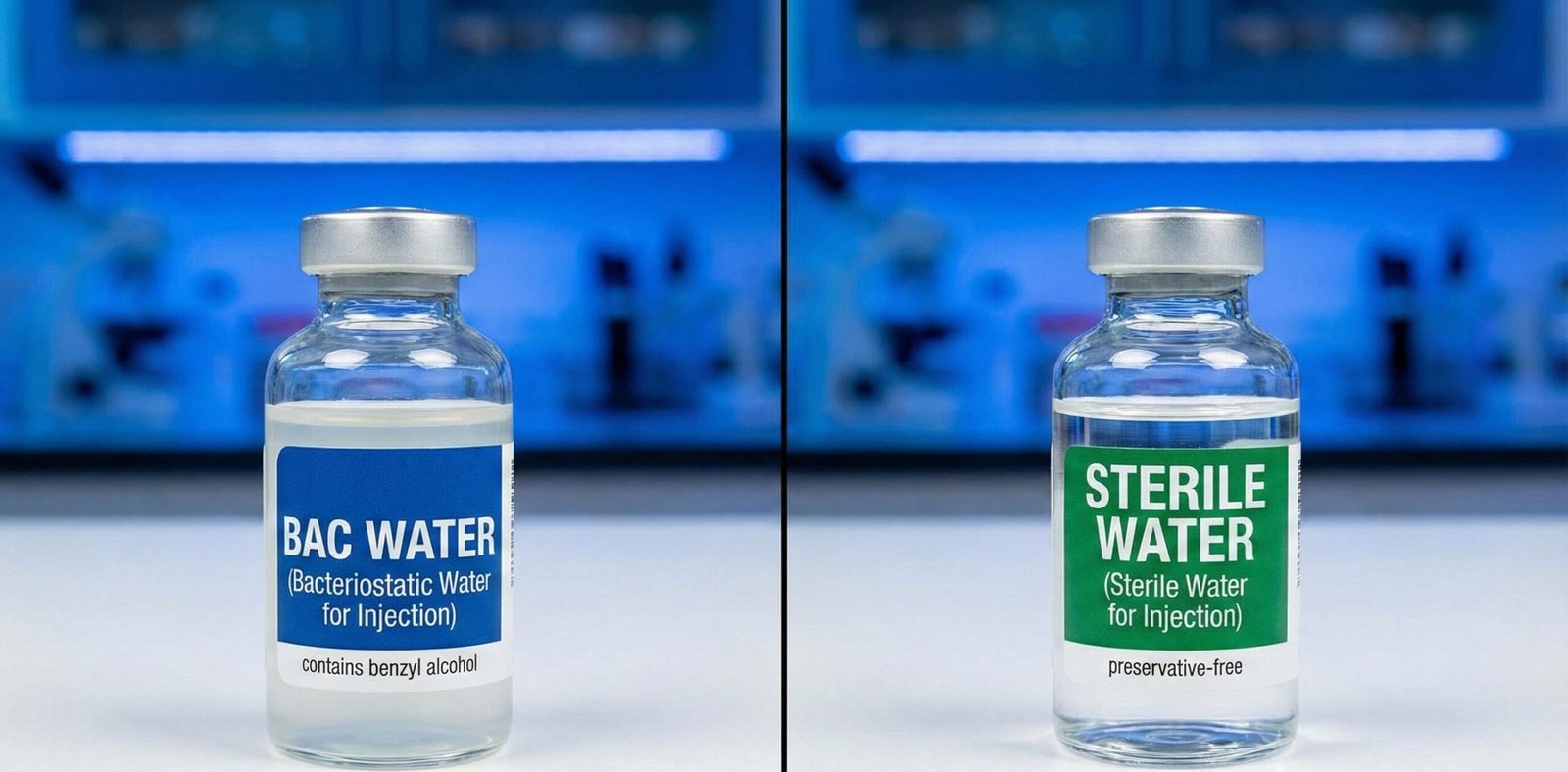
BAC Water vs. Sterile Water: Key Differences in Research Applications

Introduction
In laboratory and research environments, the choice of diluent plays a critical role in ensuring accuracy, sterility, and consistency. Two of the most commonly referenced solutions are Bacteriostatic Water (BAC Water) and Sterile Water.
While they may appear similar at first glance, these solutions serve distinct purposes in research settings. Understanding their differences is essential for selecting the appropriate option for laboratory workflows.
All materials discussed are intended strictly for research and laboratory use only and are not intended for human or veterinary use.
What Is BAC Water?
Bacteriostatic Water (BAC Water) is sterile water containing 0.9% benzyl alcohol, which acts as a bacteriostatic agent. This additive inhibits bacterial growth after the vial has been accessed, allowing for multiple withdrawals when proper aseptic techniques are followed.
BAC Water is commonly used in laboratories for the reconstitution of lyophilized research compounds where controlled, repeat access is required.
What Is Sterile Water?
Sterile Water is purified water that has been sterilized and contains no antimicrobial agents or preservatives. It is designed for single-use applications in laboratory settings, as once opened, it does not prevent microbial growth.
Because it lacks bacteriostatic properties, Sterile Water is typically used when preservatives are not desired or when protocols require immediate, one-time preparation.
Key Differences at a Glance
| Feature | BAC Water | Sterile Water |
|---|---|---|
| Preservative | Yes (benzyl alcohol) | No |
| Bacteriostatic Properties | Yes | No |
| Multi-Use Capability | Suitable for multiple withdrawals | Single-use recommended |
| Typical Research Use | Reconstitution of lyophilized compounds | Immediate dilution or preparation |
| Shelf Stability After Opening | Greater (with proper handling) | Limited |
Research Considerations When Choosing Between Them
Sterility Control
BAC Water provides additional protection against bacterial growth after vial access, making it suitable for workflows requiring repeated handling.
Sterile Water, by contrast, must be used immediately once opened to maintain sterility.
Workflow Efficiency
BAC Water supports efficient laboratory processes by reducing waste when multiple withdrawals are needed.
Sterile Water is often preferred in protocols where no preservatives are acceptable or required.
Compatibility with Research Protocols
Some experimental protocols specify the use of preservative-free solutions, making Sterile Water the appropriate choice. Others prioritize extended usability, where BAC Water is preferred.
Always follow internal laboratory guidelines and experimental design requirements when selecting a diluent.
Handling and Storage (Research Context)
For both solutions:
- Use proper aseptic laboratory techniques
- Store in controlled environments
- Discard if contamination or cloudiness is observed
- Follow laboratory disposal protocols
Important Disclaimer
Research Use Only (RUO):
BAC Water and Sterile Water supplied by Nova Lab Peptides are intended exclusively for laboratory research and analytical purposes.
They are not intended for human consumption, injection, or veterinary use.
Any application outside of approved research settings is strictly prohibited.
Conclusion
Although BAC Water and Sterile Water may appear similar, their functional differences are significant in research environments. BAC Water offers bacteriostatic protection and multi-use flexibility, while Sterile Water provides a preservative-free option for immediate, single-use applications.
Selecting the correct solution ensures consistency, sterility, and reliability in laboratory research—key principles upheld by Nova Lab Peptides.